Not now. Not this year.
I don't know if any of this blog's readers are even thinking of voting for Republicans tomorrow--after all, the party of George W. Bush and Dick Cheney have gotten us into so much trouble on so many issues, it is hard to believe anyone would.
But I can't resist one day-before-Election-Day plea, on the remote chance that anyone is undecided or thinking of staying home (and assuming you would consider taking advice from one lowly person like me): Vote for Democrats.
A vote for Republicans is a vote...
for more of the same.
for NOT holding our leaders accountable when they totally mess things up.
for allowing human beings to be tortured in our custody.
for launching unprovoked wars against countries that pose no significant threat that will kill thousands of human beings, both soldiers and civilians.
for showering tax cuts on the rich while allowing our federal budget to swell.
for absurdly scapegoating gay people for our problems while shamelessly protecting Republican sexual predators in Congress.
for taking away time-honored American freedoms such as habeus corpus.
for keeping wages low, leaving millions of people without adequate health care, less money for education, and no genuine compassion for the poor.
for an economy that mainly benefits big oil companies and weapons makers.
for using our troops as a rhetorical shield against failed policies and then failing to fully support them materially when they return home (or even in wartime).
for political corruption on a grand scale.
for ignoring serious problems, such as global warming, that will have catastrophic consequences for all of humanity.
for tolerating lies and deceptions that lead us into unwinnable and immoral wars.
Let me also speak as a Christian (sorry for those who don't resonate with my frequent references to my faith--it's just who I am) to other Christians. When you are alone in that election booth, thinking and praying about who to vote for, you will be thinking deeply about where God is calling you. Where does the message of Jesus Christ lead us in today's world? Does it lead us to support the Republicans, a party that talks a lot about "sharing our values" but then launches massive wars and violence, and that takes away from the poor and middle class (and our children) to give to big corporations and the rich? Or does it lead us to vote for a new direction by supporting Democrats, who may not be perfect, but they are far better than the Republicans at enacting our core values in the world.
Now is not the time for subtle distinctions between "moderate" and "crazy" Republicans. Now is not the time for cutting some slack to the local Republican who doesn't seem quite so bad as the rest. (And, for those of us so inclined, it isn't really the year for independent and third-party candidates either, I'm afraid.) This year's election is a referendum on the direction of our country. The more Democrats we elect to Congress (and to state legislatures, governorships, etc.), the more likely that we will be able take a new direction, which we so desperately need to do.
So if you value the continuation of American democracy, if you value accountability in government, if you cherish your liberties and freedoms, if you want to see this country start to take a new direction, and (for those who share my Christian faith) if you want leaders with Christian values: DON'T VOTE REPUBLICAN!
(And if you live in Connecticut, don't vote "Connecticut for Lieberman" either. Ned Lamont is the true--and properly nominated--Democrat who will effectively stand up to the Bush-Cheney Administration.)
See also ILJ's recent posting on his experience phone-banking to get people to the polls, for some interesting perspective on cynicism and hope in the upcoming elections.
Monday, November 06, 2006


Sunday, November 05, 2006
Employment and recessions
Listening to the news this morning, I heard several commentators note that things were bad for the Republicans, despite the economy being in good shape and unemployment very low. I won't repeat here all the evidence that the economy is not in great shape for middle- and lower-income Americans--that's it's being buoyed by record levels of debt, a frothy housing market, and Gilded Age tax policies for the wealthy. (Though if you'd like to read some of that, you might start here or here.) But I did want to highlight a chart from a recent post at Calculated Risk and its demonstration that low unemployment figures usually precede recessions:
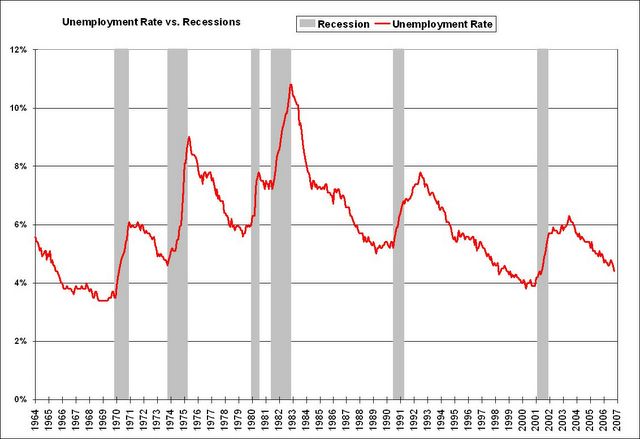
They're not predictive indicators, as the post makes clear, merely coincident. But it's a striking chart, nonetheless, and certainly puts all the shouting about low unemployment in a different light.
In fact, as economists and Wall Street types have historically been very bad at predicting recessions, it is possible that we are in a recession already. Last quarter's GDP growth officially was an anemic 1.6%, but probably closer to 0%. If Q4 is as poor, and Q3 revised downward--ta-da! A recession.
Update: Finally found a couple things I wanted to include in the post earlier. First is a link to September 8, 2006 post by Nouriel Roubini, in which he notes that "in March 2001 in a survey 95% of US economic forecasters predicted that there would not be a recession in 2001; 95% of them! Too bad that the recession had already started exactly in March of that year!" Second is an April, 2000 paper (PDF) by Prakash Loungani of the IMF, which Dr. Roubini cites, that looked at economists' predictions of GDP growth from 1989 to 1998. It concludes that "the record of failure to predict recessions is virtually unblemished."
They're not predictive indicators, as the post makes clear, merely coincident. But it's a striking chart, nonetheless, and certainly puts all the shouting about low unemployment in a different light.
In fact, as economists and Wall Street types have historically been very bad at predicting recessions, it is possible that we are in a recession already. Last quarter's GDP growth officially was an anemic 1.6%, but probably closer to 0%. If Q4 is as poor, and Q3 revised downward--ta-da! A recession.
Update: Finally found a couple things I wanted to include in the post earlier. First is a link to September 8, 2006 post by Nouriel Roubini, in which he notes that "in March 2001 in a survey 95% of US economic forecasters predicted that there would not be a recession in 2001; 95% of them! Too bad that the recession had already started exactly in March of that year!" Second is an April, 2000 paper (PDF) by Prakash Loungani of the IMF, which Dr. Roubini cites, that looked at economists' predictions of GDP growth from 1989 to 1998. It concludes that "the record of failure to predict recessions is virtually unblemished."
Friday, November 03, 2006
A Powerful Statement of Faith Witness
I have a few times before mentioned my admiration of Robert Jensen's courageous articles and commentaries, which so often go against the "conventional wisdom" of American political culture. But, wow! Jensen has really struck a chord with a recent meditation entitled "Finding my way back to church -- and getting kicked out: The struggle over what it means to be Christian today." I am a Christian myself, so maybe Jensen's words resonate especially with me. But I think even non-believers and adherents of other religious traditions will find some powerful messages in what Jensen says.
Though he is a Presbyterian, Jensen's experience could have been taken place within my own wonderfully progressive local United Methodist Church. (And, moreover, this particular commentary was delivered to the Methodist Federation for Social Action, a wonderful haven for progressive social witnessing in the UMC!) My own faith experience has been somewhat different from Jensen's: I have never really left the Church, and I am perhaps more traditional about divinity issues than him. But his statement of his belief that he issued to the committee deciding on whether to kick him out of the larger Presbyterian Church (not his local church, who support him) is a powerful statement of faith in a modern age, I think:
"On God: I believe God is a name we give to the mystery of the world that is beyond our capacity to understand. I believe that the energy of the universe is ordered by forces I cannot comprehend.
On Jesus: I believe Christ offered a way into that mystery that still has meaning today.
On the Holy Ghost: There are moments in my life when I feel a connection to other people and to Creation that rides a spirit which flows through me yet is beyond me.
I believe that Holy Spirit can only be nurtured in real community, where people make commitments to each other. I have found that community in St. Andrew’s. I have tried to open myself up to our pastor’s teaching, to the members of the congregation, and to the church’s work in the world."
(And some people want to kick this guy out of the Church?)
One more quote to chew on from Jensen's think-piece, on the relevance of the churches of Christianity, which he provocatively calls "the dominant religion of the empire, the contemporary United States":
"I’m also afraid because most of the organic institutions that could help people confront the political, economic, cultural, and ecological crises we face have been destroyed, undermined, or co-opted by a sophisticated system of domination achieved through the unholy alliance of a powerful state and predatory corporate capitalism. The dominant political parties are impediments to progressive change; unions have been gutted and marginalized; and universities serve mostly as comfortable shelters for timid intellectuals working in duck-and-cover mode. The institutions in which people traditionally have come together to learn about the world and organize to change it have mostly checked out -- except for, possibly, the church."
Just go read the whole thing; it is well worth it.
I was going to post something about the upcoming elections, but reading Jensen's statement made me realize that speaking with clarity about current events sometimes requires thinking about the bigger picture.
Though he is a Presbyterian, Jensen's experience could have been taken place within my own wonderfully progressive local United Methodist Church. (And, moreover, this particular commentary was delivered to the Methodist Federation for Social Action, a wonderful haven for progressive social witnessing in the UMC!) My own faith experience has been somewhat different from Jensen's: I have never really left the Church, and I am perhaps more traditional about divinity issues than him. But his statement of his belief that he issued to the committee deciding on whether to kick him out of the larger Presbyterian Church (not his local church, who support him) is a powerful statement of faith in a modern age, I think:
"On God: I believe God is a name we give to the mystery of the world that is beyond our capacity to understand. I believe that the energy of the universe is ordered by forces I cannot comprehend.
On Jesus: I believe Christ offered a way into that mystery that still has meaning today.
On the Holy Ghost: There are moments in my life when I feel a connection to other people and to Creation that rides a spirit which flows through me yet is beyond me.
I believe that Holy Spirit can only be nurtured in real community, where people make commitments to each other. I have found that community in St. Andrew’s. I have tried to open myself up to our pastor’s teaching, to the members of the congregation, and to the church’s work in the world."
(And some people want to kick this guy out of the Church?)
One more quote to chew on from Jensen's think-piece, on the relevance of the churches of Christianity, which he provocatively calls "the dominant religion of the empire, the contemporary United States":
"I’m also afraid because most of the organic institutions that could help people confront the political, economic, cultural, and ecological crises we face have been destroyed, undermined, or co-opted by a sophisticated system of domination achieved through the unholy alliance of a powerful state and predatory corporate capitalism. The dominant political parties are impediments to progressive change; unions have been gutted and marginalized; and universities serve mostly as comfortable shelters for timid intellectuals working in duck-and-cover mode. The institutions in which people traditionally have come together to learn about the world and organize to change it have mostly checked out -- except for, possibly, the church."
Just go read the whole thing; it is well worth it.
I was going to post something about the upcoming elections, but reading Jensen's statement made me realize that speaking with clarity about current events sometimes requires thinking about the bigger picture.
Thursday, November 02, 2006
The Big Picture on Iraq

Whatever the micro-scale realities of local calm and order in Iraq, this widely circulating image is a sobering reminder of the general trajectory under U.S. occupation.
Tuesday, October 31, 2006
Bad reporting from NPR, good news from Iraq (no, really)
Listening to NPR recently I heard two stories that are evidence 1) that media outlets such as NPR can be careless in their reporting, seemingly too eager these days to report the latest example of misconduct and malfeasance by the US in Iraq; and 2) that US forces are accomplishing some good things in Iraq.
Yesterday NPR featured a story by Tom Bowman with the headline (on their website): "Thousands of U.S.-Bought Weapons Lost in Iraq." The lede seems to confirm that at least 300,000 weapons purchased with US money have gone missing: "The U.S. military can't account for hundreds of thousands of weapons purchased to arm some 325,500 Iraqi security forces..." The written version of the report is somewhat more alarming than the original audio, however. Bowman's report was introduced by Melissa Block who told listeners that a new report indicates "...only a small percentage of the Iraqi weapons paid for by US taxpayers are registered by their serial numbers. That means, they could easily end up in the hands of insurgents." That's still pretty alarming, but not being registered by serial number is a far cry from being missing.
In fact, it doesn't appear they're missing at all. As quickly made clear in Robert Siegel's interview with Stuart Bowen, the Special Inspector General for Iraq Reconstruction, the agency that performed the audit of the weapons procurement program, the audit found that although only 2.7% of the 370,000 weapons purchased were properly registered by serial number in a DOD database, the vast majority of those weapons were accounted for as issued to Iraqi units or in warehouse. Property books did show a discrepancy of 14,000 weapons, almost all 9mm pistols, that were purchased but not in warehouse or with Iraqi units. 14,000 missing pistols is bad, but it's less than 4% of the total number of weapons purchased, and not 300,000 as the lede claims. The fact that most of the weapons, missing or not, were not registered by serial number also seems like a mistake, but it's unclear from either NPR's reporting or the SIGIR report how having a serial number in a database would prevent a weapon from, as Melissa Block said, "easily end[ing] up in the hands of insurgents." NPR's reporting in this case was very sloppy, and painted a dire picture of a program that in fact doesn't seem to be working that bad at all, all things considered (no pun intended).
(NPR is also guilty in this case of sloppy webmastering: the link they give on their site to the SIGIR report takes you to a quarterly report, which contains only a short summary of the weapons procurement program audit. If you want to read the entire audit report--where you will find all the information in the NPR piece--you need to go here, and download report SIGIR-06-033.)
Second, there's this NPR report by Jamie Tarabay on the Iraqi town of Saab al-Bur. US forces moved out of the town last month and handed security operations there over to the Iraqi police. A wave of sectarian violence broke over the town in a matter of days, and 90% of the town's residents packed up and left. This month US troops are back in the town, and the violence appears to have settled down. I'm a staunch opponent of the war, and believe that the presence of US troops in Iraq is doing more harm than good. I have no idea of the larger context of the events described in the report, or how the reporter found the story, but assuming the facts are as presented in the report, here's an example of Iraqis better able to live normal lives because US troops are there to keep order. Proponents of a US withdrawal from Iraq need to keep such stories in mind. The US has a moral obligation to the people of Iraq to help them out of the mess we've played such a large role in creating. A moral policy toward Iraq cannot begin and end with bringing US troops home.
Let me end this over-long post by bringing up one more NPR story--one that I found very informative. Guy Raz is doing a series of reports on rhetoric of the Global War on Terror (Global Struggle Against Violent Extremism [GSAVE], World Conflict Against Islamo-Fascism [WCAIF], Clash of Civilizations [CoC], Armageddon [OhCrap]). His first report was on the word 'jihad,' and how its use to describe terrorists almost automatically puts the US at a disadvantage in convincing Muslims that the war on terror is not a war on Islam. A political scientist at Johns Hopkins, Mary Habeck, has been urging politicians to use the term 'jihadists' to describe Islamic terrorists, arguing that today the term means only one thing: "Violence and violence alone to attain their ends." It will not surprise anyone familiar with the background of most Bush administration foreign policy types that Prof. Habeck's background is in studies of Russian and the former Soviet Union, not the Middle East or Islamic studies. Other experts, such as Douglas Streusand, Islamic historian and professor of military history at American Military University, UCLA law professor Khaled Abu El Fadl, and NPR's own commentator Anisa Mehdi (way back in January, 2005) disagree. They propose a different word--'hirabis,' which translates as 'brigands' or 'sinful warriors'--instead of 'jihadists' to refer to terrorists. It's a good idea, I think. Raz's report is quite interesting, and deserves a listen (or a read).
After doing some Googling of her name, Habek seems to me like another in a long line of 'experts' on the Middle East who have the ear of American policy makers, but who do not have sufficient training in Islamic history and languages to warrant their status as experts. And my cynical thought is that focus groups have told the Bush administration that 'jihadists' works best at scaring the American public, and that they'd much rather do that than use a word more likely to make the interests of the country clearer to Muslims. I would go a step further and say that there's something about the conservative Republican ideology that revels in the gratuitous insult, even if its counterproductive to the policies they claim to support, but that's another post.
Yesterday NPR featured a story by Tom Bowman with the headline (on their website): "Thousands of U.S.-Bought Weapons Lost in Iraq." The lede seems to confirm that at least 300,000 weapons purchased with US money have gone missing: "The U.S. military can't account for hundreds of thousands of weapons purchased to arm some 325,500 Iraqi security forces..." The written version of the report is somewhat more alarming than the original audio, however. Bowman's report was introduced by Melissa Block who told listeners that a new report indicates "...only a small percentage of the Iraqi weapons paid for by US taxpayers are registered by their serial numbers. That means, they could easily end up in the hands of insurgents." That's still pretty alarming, but not being registered by serial number is a far cry from being missing.
In fact, it doesn't appear they're missing at all. As quickly made clear in Robert Siegel's interview with Stuart Bowen, the Special Inspector General for Iraq Reconstruction, the agency that performed the audit of the weapons procurement program, the audit found that although only 2.7% of the 370,000 weapons purchased were properly registered by serial number in a DOD database, the vast majority of those weapons were accounted for as issued to Iraqi units or in warehouse. Property books did show a discrepancy of 14,000 weapons, almost all 9mm pistols, that were purchased but not in warehouse or with Iraqi units. 14,000 missing pistols is bad, but it's less than 4% of the total number of weapons purchased, and not 300,000 as the lede claims. The fact that most of the weapons, missing or not, were not registered by serial number also seems like a mistake, but it's unclear from either NPR's reporting or the SIGIR report how having a serial number in a database would prevent a weapon from, as Melissa Block said, "easily end[ing] up in the hands of insurgents." NPR's reporting in this case was very sloppy, and painted a dire picture of a program that in fact doesn't seem to be working that bad at all, all things considered (no pun intended).
(NPR is also guilty in this case of sloppy webmastering: the link they give on their site to the SIGIR report takes you to a quarterly report, which contains only a short summary of the weapons procurement program audit. If you want to read the entire audit report--where you will find all the information in the NPR piece--you need to go here, and download report SIGIR-06-033.)
Second, there's this NPR report by Jamie Tarabay on the Iraqi town of Saab al-Bur. US forces moved out of the town last month and handed security operations there over to the Iraqi police. A wave of sectarian violence broke over the town in a matter of days, and 90% of the town's residents packed up and left. This month US troops are back in the town, and the violence appears to have settled down. I'm a staunch opponent of the war, and believe that the presence of US troops in Iraq is doing more harm than good. I have no idea of the larger context of the events described in the report, or how the reporter found the story, but assuming the facts are as presented in the report, here's an example of Iraqis better able to live normal lives because US troops are there to keep order. Proponents of a US withdrawal from Iraq need to keep such stories in mind. The US has a moral obligation to the people of Iraq to help them out of the mess we've played such a large role in creating. A moral policy toward Iraq cannot begin and end with bringing US troops home.
Let me end this over-long post by bringing up one more NPR story--one that I found very informative. Guy Raz is doing a series of reports on rhetoric of the Global War on Terror (Global Struggle Against Violent Extremism [GSAVE], World Conflict Against Islamo-Fascism [WCAIF], Clash of Civilizations [CoC], Armageddon [OhCrap]). His first report was on the word 'jihad,' and how its use to describe terrorists almost automatically puts the US at a disadvantage in convincing Muslims that the war on terror is not a war on Islam. A political scientist at Johns Hopkins, Mary Habeck, has been urging politicians to use the term 'jihadists' to describe Islamic terrorists, arguing that today the term means only one thing: "Violence and violence alone to attain their ends." It will not surprise anyone familiar with the background of most Bush administration foreign policy types that Prof. Habeck's background is in studies of Russian and the former Soviet Union, not the Middle East or Islamic studies. Other experts, such as Douglas Streusand, Islamic historian and professor of military history at American Military University, UCLA law professor Khaled Abu El Fadl, and NPR's own commentator Anisa Mehdi (way back in January, 2005) disagree. They propose a different word--'hirabis,' which translates as 'brigands' or 'sinful warriors'--instead of 'jihadists' to refer to terrorists. It's a good idea, I think. Raz's report is quite interesting, and deserves a listen (or a read).
After doing some Googling of her name, Habek seems to me like another in a long line of 'experts' on the Middle East who have the ear of American policy makers, but who do not have sufficient training in Islamic history and languages to warrant their status as experts. And my cynical thought is that focus groups have told the Bush administration that 'jihadists' works best at scaring the American public, and that they'd much rather do that than use a word more likely to make the interests of the country clearer to Muslims. I would go a step further and say that there's something about the conservative Republican ideology that revels in the gratuitous insult, even if its counterproductive to the policies they claim to support, but that's another post.
Subscribe to:
Posts (Atom)