Thursday, October 27, 2005
Ruy Teixeira on Bartels's 'working class'
Teixeira's analysis of Larry Bartels's paper (PDF) brings up the same issue as Christian_Left did in his comments to my previous post, but adds details about the prevailing definition of 'working class' and how the demographics of Bartels's 'working class' match that definition. The recent Teixeira post contains a link to a May 7 post wherein he recapitulates his reasons for defining the working class by the absense of a college degree, defending that definition (somewhat tentatively) against the criticism of Chris Bowers.


Tuesday, October 25, 2005
Party identification and education, 1972-2002
More data from the National Election Studies Guide.
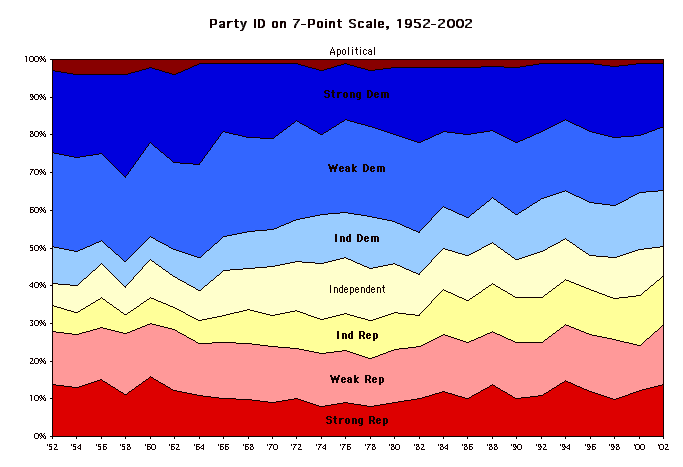
The first chart shows how respondents of the NES surveys identified themselves according to a 7-point scale of partisanship, from 'Strong Democrat,' to 'Independent,' to 'Strong Republican,' or simply 'Apolitical.' Note that these data go back to 1952, whereas data presented in the previous post on ideological identification went back only to 1972.
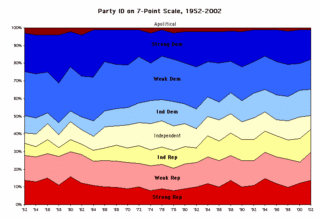
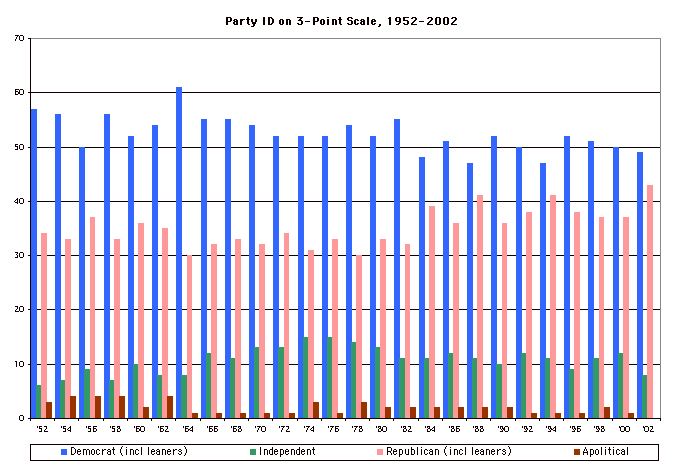
The next chart simplifies matters somewhat by showing responses to a 3-point scale of 'Democrat,' 'Independent,' or 'Republican.' Again, the data goes back to 1952.
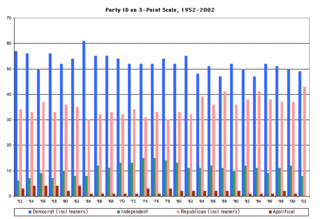
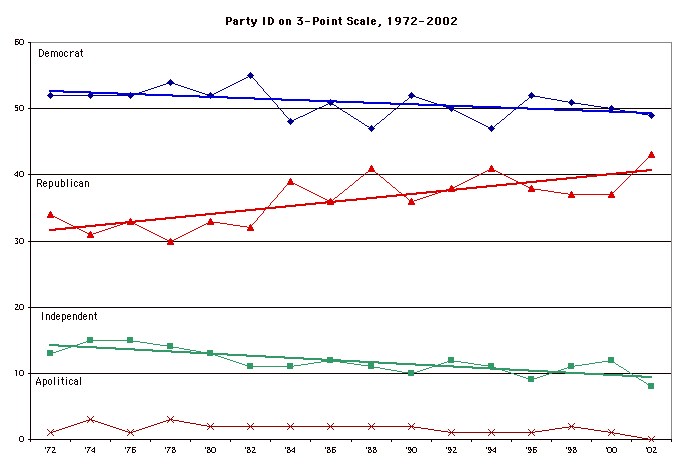
The chart below shows linear trends in 3-point scale party identification. Note that to make the data on party ID easily comparable to that on ideological ID, this chart goes back only to 1972, not 1952.
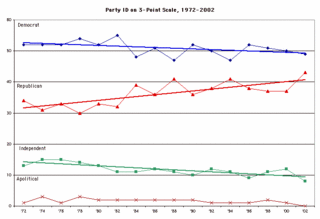
Finally, recapitulating the presentation on ideological ID, here are charts of the trends in party identification among the different education demographics groups. Comparisons between the fortunes of the Democrats and Republicans are easier when the data for each demographic group is considered separately.
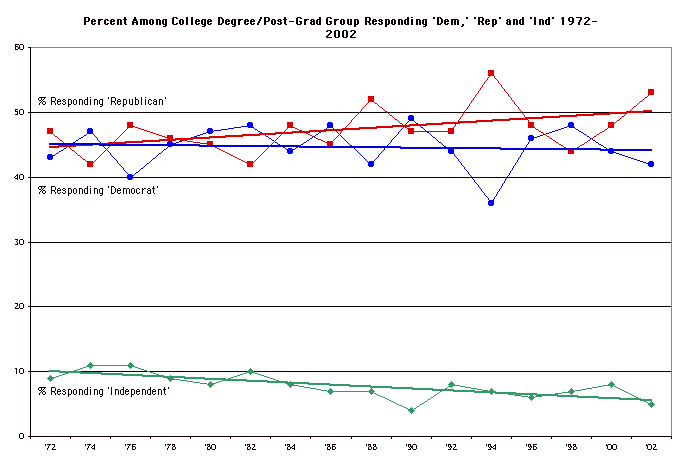
This first chart looks at party identification among college graduates and post-graduates:
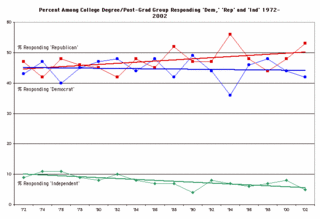
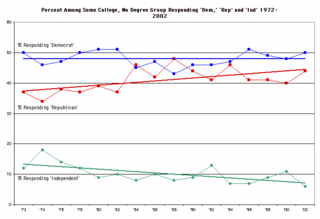
Working our way down the educational ladder, here is how party identification has broken down among NES respondents who have some college, but no degree:
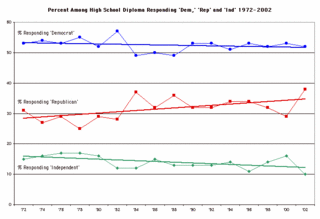
High school graduates who have no college:
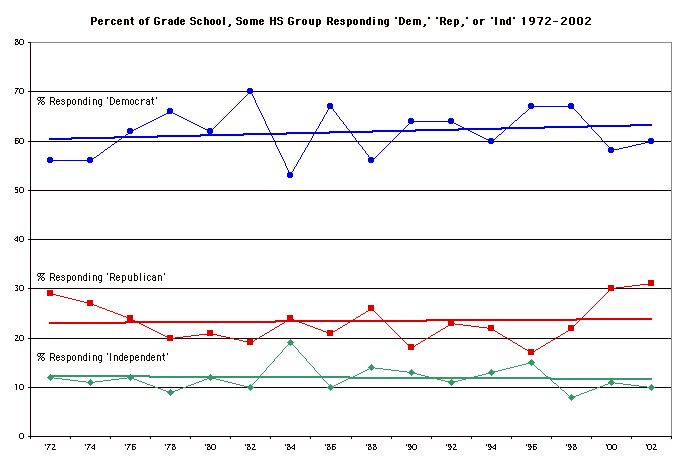
And finally, respondents who have some grade school or high school, but no high school diploma:
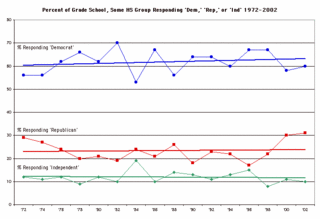
To me these charts represent some problems for the Thomas Frank thesis that Democrats have lost elections because they have conceeded their working class base to backlash conservatism. Democratic identification has decreased since 1972 in all educational groups except among those with no high school diploma. Not good for the Dems but hardly evidence of a particular errosion of their support among the working class (if you choose to define 'working class' by education level). Moreover, where Dems have seen loses and Republicans gains, Republicans seem to be having more success attracting independent voters than they are taking away from the Democratic base.
[Update: Frank's thesis pertains to loss of Democratic support among the White working class. The data presented here is not limited to that group, and so can only serve as background for evaluation of Frank's contention.]
Of course, one need not accept the NES data as the final word on the subject. Indeed, one large flaw in the percentages presented here is that I've not given the N of the educational groups. Those numbers can be found here, however, for those interested in reviewing them. The more statistically sophisticated might also quarrel with the way NES has weighted responses. These issues are beyond my grasp, sadly, but if you want to argue with the NES, information on their weighting methods can be found here.
While readers are digesting all these charts, I will be away from my computer until the weekend at the earliest. But after that, I will post more information from the NES, and, of course, respond to any comments.
The first chart shows how respondents of the NES surveys identified themselves according to a 7-point scale of partisanship, from 'Strong Democrat,' to 'Independent,' to 'Strong Republican,' or simply 'Apolitical.' Note that these data go back to 1952, whereas data presented in the previous post on ideological identification went back only to 1972.
The next chart simplifies matters somewhat by showing responses to a 3-point scale of 'Democrat,' 'Independent,' or 'Republican.' Again, the data goes back to 1952.
The chart below shows linear trends in 3-point scale party identification. Note that to make the data on party ID easily comparable to that on ideological ID, this chart goes back only to 1972, not 1952.
Finally, recapitulating the presentation on ideological ID, here are charts of the trends in party identification among the different education demographics groups. Comparisons between the fortunes of the Democrats and Republicans are easier when the data for each demographic group is considered separately.
This first chart looks at party identification among college graduates and post-graduates:
Working our way down the educational ladder, here is how party identification has broken down among NES respondents who have some college, but no degree:

High school graduates who have no college:

And finally, respondents who have some grade school or high school, but no high school diploma:
[Update: Frank's thesis pertains to loss of Democratic support among the White working class. The data presented here is not limited to that group, and so can only serve as background for evaluation of Frank's contention.]
Of course, one need not accept the NES data as the final word on the subject. Indeed, one large flaw in the percentages presented here is that I've not given the N of the educational groups. Those numbers can be found here, however, for those interested in reviewing them. The more statistically sophisticated might also quarrel with the way NES has weighted responses. These issues are beyond my grasp, sadly, but if you want to argue with the NES, information on their weighting methods can be found here.
While readers are digesting all these charts, I will be away from my computer until the weekend at the earliest. But after that, I will post more information from the NES, and, of course, respond to any comments.
Monday, October 24, 2005
Education level and ideological identification
Here is a chart-o-rama, courtesy of numbers from the National Election Studies Guide.
These data pertain to survey questions asked of voters during elections from the years 1972 to 2002. The self-identification question, with slight variations in some years, asked respondents "When it comes to politics do you usually think of yourself as extremely liberal, liberal, slightly liberal, moderate or middle of the road, slightly conservative, conservative, extremely conservative, or haven't you thought much about this?" The first chart shows how respondents broke down by each category:
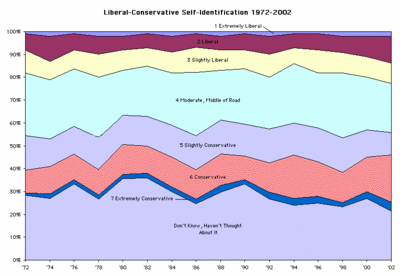
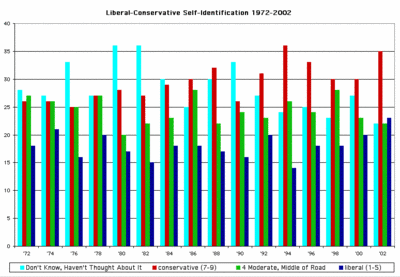
Voters with very strong ideological commitments--identifying as either 'extremely' conservative or liberal--have been and remain fairly small sections of the electorate. More voters recently (especially since 2000) identify as 'conservative,' but the 'liberal' category has seen growth as well.
These trends become more apparent when the liberal and conservative voters are grouped into only two categories, regardless of the strength of their liberal or conservative feelings. (Ignore the numbers after the data labels in the key--they don't refer to the actual category numbers.)
The linear trends of the same data show the changes even more clearly:
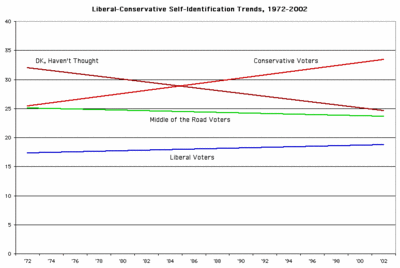
Conservatives have increased considerably, but those increases seem not to have come at the expense of liberals. The number of voters identifying as liberal has, in fact, increased, though at a markedly slower rate than increases in conservatives. The greater numbers of conservatives appear to be drawn from the ranks of middle-of-the-road voters and those who hadn't previously thought about their position on the ideological spectrum.
So how is education related to ideological self-identification? These charts break down conservative and liberal voters according to education level:
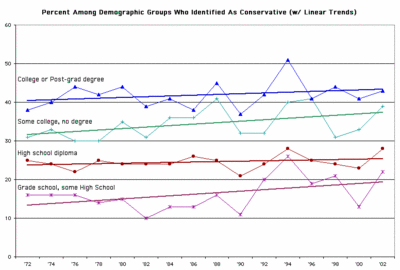

Conservative voters have increased in all educational categories, though the slope of the increase is steepest for voters who have had some college, but no degree, and those who did not finish high school. Liberals have lost ground among all educational groups except those who did not finish high school, where they show slight gains. Liberal declines have been steepest among those with some college but no degree, yet the slope of those losses is nearly identical to that of losses among college graduates.
Coming next post: data on party identification (as opposed to ideological identification) and education.
These data pertain to survey questions asked of voters during elections from the years 1972 to 2002. The self-identification question, with slight variations in some years, asked respondents "When it comes to politics do you usually think of yourself as extremely liberal, liberal, slightly liberal, moderate or middle of the road, slightly conservative, conservative, extremely conservative, or haven't you thought much about this?" The first chart shows how respondents broke down by each category:

Voters with very strong ideological commitments--identifying as either 'extremely' conservative or liberal--have been and remain fairly small sections of the electorate. More voters recently (especially since 2000) identify as 'conservative,' but the 'liberal' category has seen growth as well.
These trends become more apparent when the liberal and conservative voters are grouped into only two categories, regardless of the strength of their liberal or conservative feelings. (Ignore the numbers after the data labels in the key--they don't refer to the actual category numbers.)

The linear trends of the same data show the changes even more clearly:

Conservatives have increased considerably, but those increases seem not to have come at the expense of liberals. The number of voters identifying as liberal has, in fact, increased, though at a markedly slower rate than increases in conservatives. The greater numbers of conservatives appear to be drawn from the ranks of middle-of-the-road voters and those who hadn't previously thought about their position on the ideological spectrum.
So how is education related to ideological self-identification? These charts break down conservative and liberal voters according to education level:


Conservative voters have increased in all educational categories, though the slope of the increase is steepest for voters who have had some college, but no degree, and those who did not finish high school. Liberals have lost ground among all educational groups except those who did not finish high school, where they show slight gains. Liberal declines have been steepest among those with some college but no degree, yet the slope of those losses is nearly identical to that of losses among college graduates.
Coming next post: data on party identification (as opposed to ideological identification) and education.
Friday, October 21, 2005
Observing the Center for Moral Clarity
This is a somewhat rambling post, but there have been a few things lately that I wanted to discuss, and I have crammed them into a single post even if they are only vaguely related.
The link in the title of this post will take you to a nice article by Bill Berkowitz at Working For Change about the conservative Christians seeking to dominate the Ohio Republican party. And today Ohio, tomorrow who knows where the Patriot Pastors will next focus? At the center of the movement (with its own Center for Moral Clarity) is a 10-12 thousand-member non-denominational church. I have to admit that I've never really understood the appeal of these mega-churches. Though I don't count myself as a terribly religious person, I have been in the past, and I can certainly understand the appeal of religion, and of a traditional church. But being part of a congregation numbering in the thousands seems more like being a groupie or a fan at a rock concert than being at church. Anyway--I wonder if the Ohio church's push for theocracy (a term they themselves use to characterize what they advocate) is typical of the mega-church movement. If so, that's scary. Though on the one hand I think that mass movements like this tend to burn themselves out--see the long list of fallen charismatic leaders from Billy Sunday to Jim Baker--I'd bet that these more infamous cases are just the most visible (and most volatile) points of a larger, more sustained movement in the suburbs and ex-urbs of America.
Somewhat related is a paper by Larry M. Bartels, "What's the Matter with What's the Matter with Kansas?" (You can download a 600K PDF of the paper here.) Bartels takes a look at statistics on White voters' behavior over the last 30 years or so to test Thomas Frank's thesis that the Democratic party has lost the allegiance of the White working class. That thesis is not supported by the statistics, he says, showing that "[W]hile it is generally true that Democratic presidential candidates have lost support among white voters over the past half-century, those losses have been entirely (and roughly equally) concentrated in the middle- and upper-income groups, and have been partially offset by *increasing* support for Democratic candidates among low-income white voters" (14).
I'm not sure if the White middle- and upper-classes that Bartels shows becoming more conservative are the same people flocking to ex-urban mega-churches (indeed, the Ohio church featured in the Berkowitz article seems to focus on African-Americans), but certainly in Ohio in 2004 it was the suburban and ex-urban Republican vote that provided critical support for Bush.
Although I find Bartels's paper pretty convincing, I don't necessarily agree with his advice to the Democratic party. He pretends, as any scholar giving a conference paper will, to not be giving advice at all. But he concludes by saying that the statistics "suggest that 'recruiting affluent, white-collar professionals who are liberal on social issues' may not be such a 'criminally stupid strategy' on the part of the Democratic leaders (Frank 2004, 243). Indeed, it may be a testament to the success of that strategy that affluent white voters have not become even more markedly Republican..." (33). As Bartels admitted in a Summer 2004 article, the strategy he envisions is essentially a short-term one, summed up in the pragmatic, if amoral, advice "here is my game plan. First, win. Second, govern. Third, win again. Fourth, keep at it." A significant problem with this advice, however, is that with the exception of the two (Perot-influenced) Clinton wins, is that it hasn't worked, and Dems have lost ground in congressional and state elections as well as presidential.
A different version much the same flawed advice is given in a new paper by William A. Galston and Elaine C. Kamarck of the Third Way Project. (You can dowload a PDF of that paper from the Third Way web site.) Their 1989 paper, "The Politics of Evasion," was widely seen as a manifesto for Clinton's triangulation strategy, and the "Politics of Polarization" is meant to inspire more Clintonesque candidates in the next election cycle, and to warn the Democratic party against tilting too far to the left. The Galston and Kamarck paper, however, offers at best contradictory advice to Dems: they want candidates who "stand for something," aren't afraid to talk about cultural issues, and who can sound tough and credible on national security. But the paper is devoid of specific policy recommendations or governing principles other than to say that Dems should move to closer to those views already held by most Americans. In short, they want a candidate who stands for whatever polling data tells him or her to stand for. Reaction to the paper from leading political web logs has been fairly mixed, but most readers seem unimpressed (see, for example, this from Paul Waldman, and this from Mark Schmitt).
Getting back to mega-churches, I would like to know how the growth of the mega-church movement fits with Bartels's finding that the middle- and upper-class White voters who have been moving to the Republican party still remain fairly liberal on social issues. Perhaps I am wrong in thinking that many mega-church goers are middle- and upper-class Whites, or perhaps the mega-churches are more diverse on social issues than those in Ohio profiled by the Berkowitz article, or perhaps White middle- and upper-class mega-church goers can feel personally more liberal on social issues yet still attend very conservative churches.
The link in the title of this post will take you to a nice article by Bill Berkowitz at Working For Change about the conservative Christians seeking to dominate the Ohio Republican party. And today Ohio, tomorrow who knows where the Patriot Pastors will next focus? At the center of the movement (with its own Center for Moral Clarity) is a 10-12 thousand-member non-denominational church. I have to admit that I've never really understood the appeal of these mega-churches. Though I don't count myself as a terribly religious person, I have been in the past, and I can certainly understand the appeal of religion, and of a traditional church. But being part of a congregation numbering in the thousands seems more like being a groupie or a fan at a rock concert than being at church. Anyway--I wonder if the Ohio church's push for theocracy (a term they themselves use to characterize what they advocate) is typical of the mega-church movement. If so, that's scary. Though on the one hand I think that mass movements like this tend to burn themselves out--see the long list of fallen charismatic leaders from Billy Sunday to Jim Baker--I'd bet that these more infamous cases are just the most visible (and most volatile) points of a larger, more sustained movement in the suburbs and ex-urbs of America.
Somewhat related is a paper by Larry M. Bartels, "What's the Matter with What's the Matter with Kansas?" (You can download a 600K PDF of the paper here.) Bartels takes a look at statistics on White voters' behavior over the last 30 years or so to test Thomas Frank's thesis that the Democratic party has lost the allegiance of the White working class. That thesis is not supported by the statistics, he says, showing that "[W]hile it is generally true that Democratic presidential candidates have lost support among white voters over the past half-century, those losses have been entirely (and roughly equally) concentrated in the middle- and upper-income groups, and have been partially offset by *increasing* support for Democratic candidates among low-income white voters" (14).
I'm not sure if the White middle- and upper-classes that Bartels shows becoming more conservative are the same people flocking to ex-urban mega-churches (indeed, the Ohio church featured in the Berkowitz article seems to focus on African-Americans), but certainly in Ohio in 2004 it was the suburban and ex-urban Republican vote that provided critical support for Bush.
Although I find Bartels's paper pretty convincing, I don't necessarily agree with his advice to the Democratic party. He pretends, as any scholar giving a conference paper will, to not be giving advice at all. But he concludes by saying that the statistics "suggest that 'recruiting affluent, white-collar professionals who are liberal on social issues' may not be such a 'criminally stupid strategy' on the part of the Democratic leaders (Frank 2004, 243). Indeed, it may be a testament to the success of that strategy that affluent white voters have not become even more markedly Republican..." (33). As Bartels admitted in a Summer 2004 article, the strategy he envisions is essentially a short-term one, summed up in the pragmatic, if amoral, advice "here is my game plan. First, win. Second, govern. Third, win again. Fourth, keep at it." A significant problem with this advice, however, is that with the exception of the two (Perot-influenced) Clinton wins, is that it hasn't worked, and Dems have lost ground in congressional and state elections as well as presidential.
A different version much the same flawed advice is given in a new paper by William A. Galston and Elaine C. Kamarck of the Third Way Project. (You can dowload a PDF of that paper from the Third Way web site.) Their 1989 paper, "The Politics of Evasion," was widely seen as a manifesto for Clinton's triangulation strategy, and the "Politics of Polarization" is meant to inspire more Clintonesque candidates in the next election cycle, and to warn the Democratic party against tilting too far to the left. The Galston and Kamarck paper, however, offers at best contradictory advice to Dems: they want candidates who "stand for something," aren't afraid to talk about cultural issues, and who can sound tough and credible on national security. But the paper is devoid of specific policy recommendations or governing principles other than to say that Dems should move to closer to those views already held by most Americans. In short, they want a candidate who stands for whatever polling data tells him or her to stand for. Reaction to the paper from leading political web logs has been fairly mixed, but most readers seem unimpressed (see, for example, this from Paul Waldman, and this from Mark Schmitt).
Getting back to mega-churches, I would like to know how the growth of the mega-church movement fits with Bartels's finding that the middle- and upper-class White voters who have been moving to the Republican party still remain fairly liberal on social issues. Perhaps I am wrong in thinking that many mega-church goers are middle- and upper-class Whites, or perhaps the mega-churches are more diverse on social issues than those in Ohio profiled by the Berkowitz article, or perhaps White middle- and upper-class mega-church goers can feel personally more liberal on social issues yet still attend very conservative churches.
Wednesday, October 19, 2005
More on Faith and Patriotism
"Christ speaks of compassion without boundaries ... Flags are about separation, assertions of superiority and aggression. The whole notion that loyalty to country is connected to one's religious faith is totally bizarre and unjustified."
-- Stephen Kolbasa, commenting on his recent dismissal as Catholic school teacher
(quoted in WCBS news radio report)
Although I identify myself with a Protestant version of Christianity, I have to declare my strong support of former Catholic school teacher Stephen Kolbasa, who was recently fired from his job for refusing to permanently display a national flag in his classroom. I first saw this story on my favorite news and views website, commondreams.org, which has reprinted a brief article on Kolbasa's firing that originally appeared in The Progressive.
Intrigued by the story, I decided to dig a little deeper. I discovered that Kolbasa has a long record of peace activism in Connecticut. His deep and abiding commitment to a socially engaged form of faith reminds me of an anti-nuclear event I attended with my sister several years ago, at which people of many different faiths who were dedicated to lives of activism. Many of them lived in near poverty and the amazing lack of materialistic goals really impressed me. Throughout the multi-day event, the participants all slept on a Catholic high school gymnasium floor. Many of them were part of the Catholic Social Worker movement, which (as I understand it, and I may even be getting the name wrong) promotes simple living and dedicating one's life to activism against war, violence, injustice, and inequality. But there were also Protestant like us, Buddhists, Muslims, Jews, etc.
Learning more about Kolbasa also led me to an intriguing website that maps the vast field of nuclear missile silos in the sparsely-populated Great Plains grassland area where Colorado, Wyoming, and Nebraska come together. This is one of my favorite parts of the world, and it is shocking to see how many weapons of mass destruction cover the landscape there. It makes something abstract like the U.S. nuclear capability somehow more tangible and frightening. I've driven by a few of these silos while driving the gravel backroads, but it is something else to see them all mapped out.
I say all of this as an American citizen who deeply loves the United States: its beautiful landscapes, its diverse people, its small towns, its backroads, its countryside, etc. To me, patriotism is a huge moral problem but loving my country is part of who I am. (Loving the current government and devoting myself to idolatrous symbols such as the flag are not part of that, however!) I believe that my love of my country is utterly contingent on my own life story and is not a claim that America is better than any other country or that the lives of my fellow Americans have any more value than others (as, for example, the intense public concern over U.S. casualties in Iraq while glossing over the much greater number of deaths of Iraqis suggests). Having lived overseas before and now again, I can say that there are good and bad things about every country. Americans are not unique in their "love of freedom" or their commitment to democracy. We have much to learn from other countries, and they have much to learn from us. I will always, however, have a special place in my heart for the people, places, and ideals that form a part of who I am as an American. But I also believe that God is working through places and people all around the world, not just in the USA--and like Stephen Kolbasa, I cannot countenance mixing my Christian faith with nationalistic symbols.
-- Stephen Kolbasa, commenting on his recent dismissal as Catholic school teacher
(quoted in WCBS news radio report)
Although I identify myself with a Protestant version of Christianity, I have to declare my strong support of former Catholic school teacher Stephen Kolbasa, who was recently fired from his job for refusing to permanently display a national flag in his classroom. I first saw this story on my favorite news and views website, commondreams.org, which has reprinted a brief article on Kolbasa's firing that originally appeared in The Progressive.
Intrigued by the story, I decided to dig a little deeper. I discovered that Kolbasa has a long record of peace activism in Connecticut. His deep and abiding commitment to a socially engaged form of faith reminds me of an anti-nuclear event I attended with my sister several years ago, at which people of many different faiths who were dedicated to lives of activism. Many of them lived in near poverty and the amazing lack of materialistic goals really impressed me. Throughout the multi-day event, the participants all slept on a Catholic high school gymnasium floor. Many of them were part of the Catholic Social Worker movement, which (as I understand it, and I may even be getting the name wrong) promotes simple living and dedicating one's life to activism against war, violence, injustice, and inequality. But there were also Protestant like us, Buddhists, Muslims, Jews, etc.
Learning more about Kolbasa also led me to an intriguing website that maps the vast field of nuclear missile silos in the sparsely-populated Great Plains grassland area where Colorado, Wyoming, and Nebraska come together. This is one of my favorite parts of the world, and it is shocking to see how many weapons of mass destruction cover the landscape there. It makes something abstract like the U.S. nuclear capability somehow more tangible and frightening. I've driven by a few of these silos while driving the gravel backroads, but it is something else to see them all mapped out.
I say all of this as an American citizen who deeply loves the United States: its beautiful landscapes, its diverse people, its small towns, its backroads, its countryside, etc. To me, patriotism is a huge moral problem but loving my country is part of who I am. (Loving the current government and devoting myself to idolatrous symbols such as the flag are not part of that, however!) I believe that my love of my country is utterly contingent on my own life story and is not a claim that America is better than any other country or that the lives of my fellow Americans have any more value than others (as, for example, the intense public concern over U.S. casualties in Iraq while glossing over the much greater number of deaths of Iraqis suggests). Having lived overseas before and now again, I can say that there are good and bad things about every country. Americans are not unique in their "love of freedom" or their commitment to democracy. We have much to learn from other countries, and they have much to learn from us. I will always, however, have a special place in my heart for the people, places, and ideals that form a part of who I am as an American. But I also believe that God is working through places and people all around the world, not just in the USA--and like Stephen Kolbasa, I cannot countenance mixing my Christian faith with nationalistic symbols.
Subscribe to:
Posts (Atom)